# Constants
c = 3e8 #light speed
Pi = 100e-3 #Input optical power(100mW)
a = mp.mpf("3e-6")  # Radius of particles (3um)
n_p = mp.mpf("1.5")  # Refractive index of particles (glass)
n_m = mp.mpf("1.33")  # Refractive index of medium (water)
n_i = mp.mpf("1.515")  # Refractive index of medium (oil)
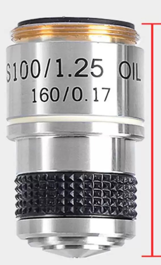
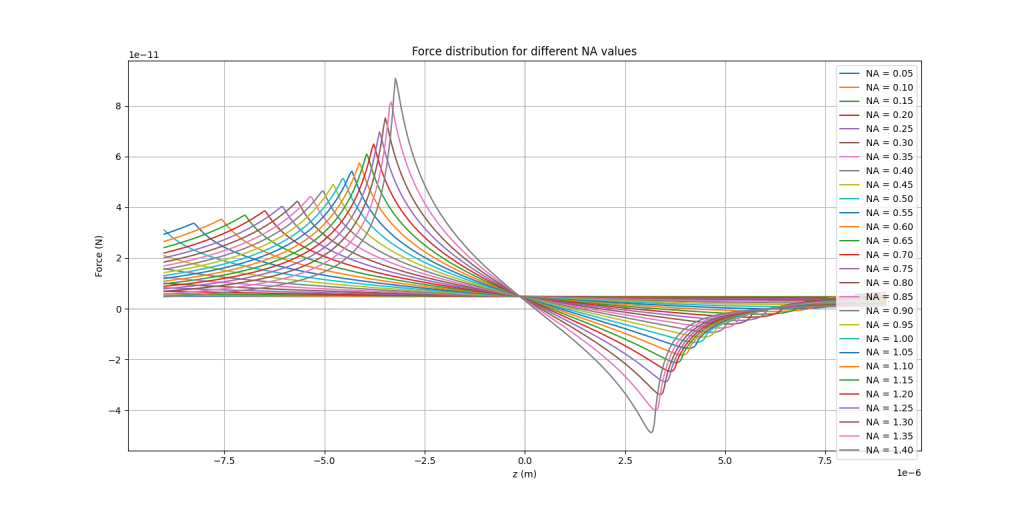
NA = mp.mpf("1.25")  # Numerical aperture (objective)
f = mp.mpf("0.3e-3")  # Focal length of objective (WD0.13+Coverslip0.17mm)

# Compute parameters
sin_theta0 = NA / n_i
cos_theta0 = mp.sqrt(1 - sin_theta0**2)
tan_theta0 = sin_theta0 / cos_theta0
r0 = f * tan_theta0  # Maximum radial extent

#Build a 3D model with uneven power based on the above parameters using Ashkin scattering formulas.
#...
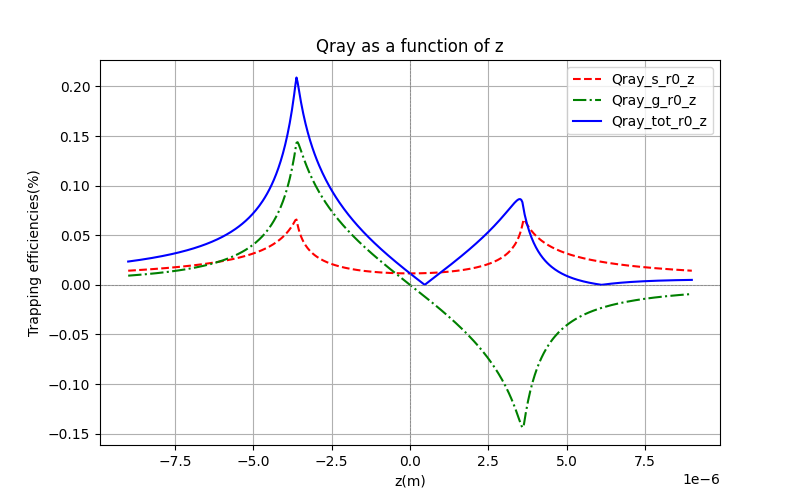
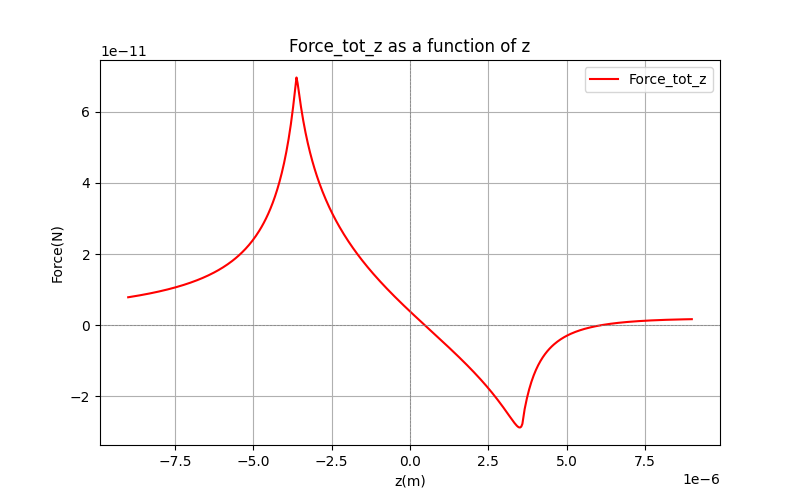
結果は次のようになります:
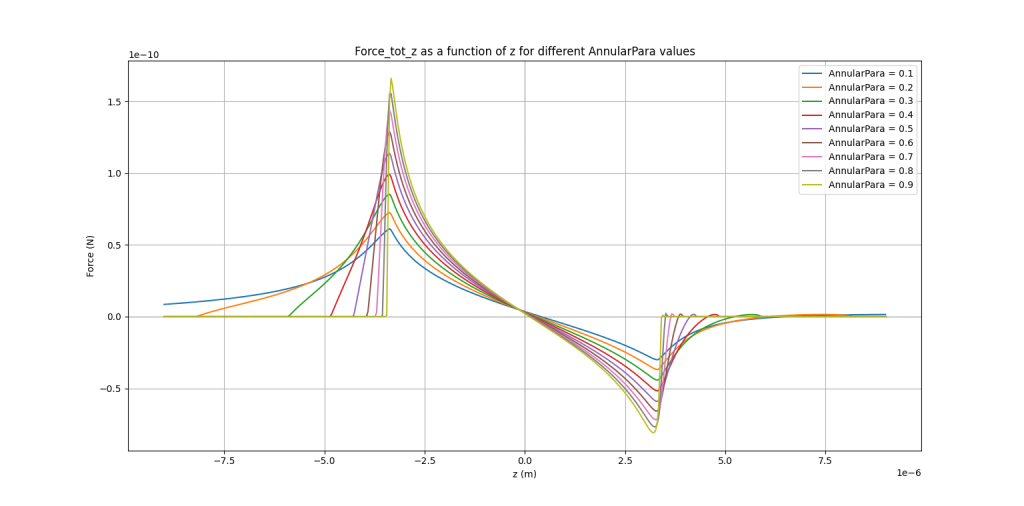
レーザー光源に近い側の光の壁のほうが、反対側より実際には強いことがわかります。入り方を誤ると安定した捕捉はできません。たとえば粒子が z 軸上の次の位置にあるときにレーザーを点けると $z < -7.5$ um、こうなります: